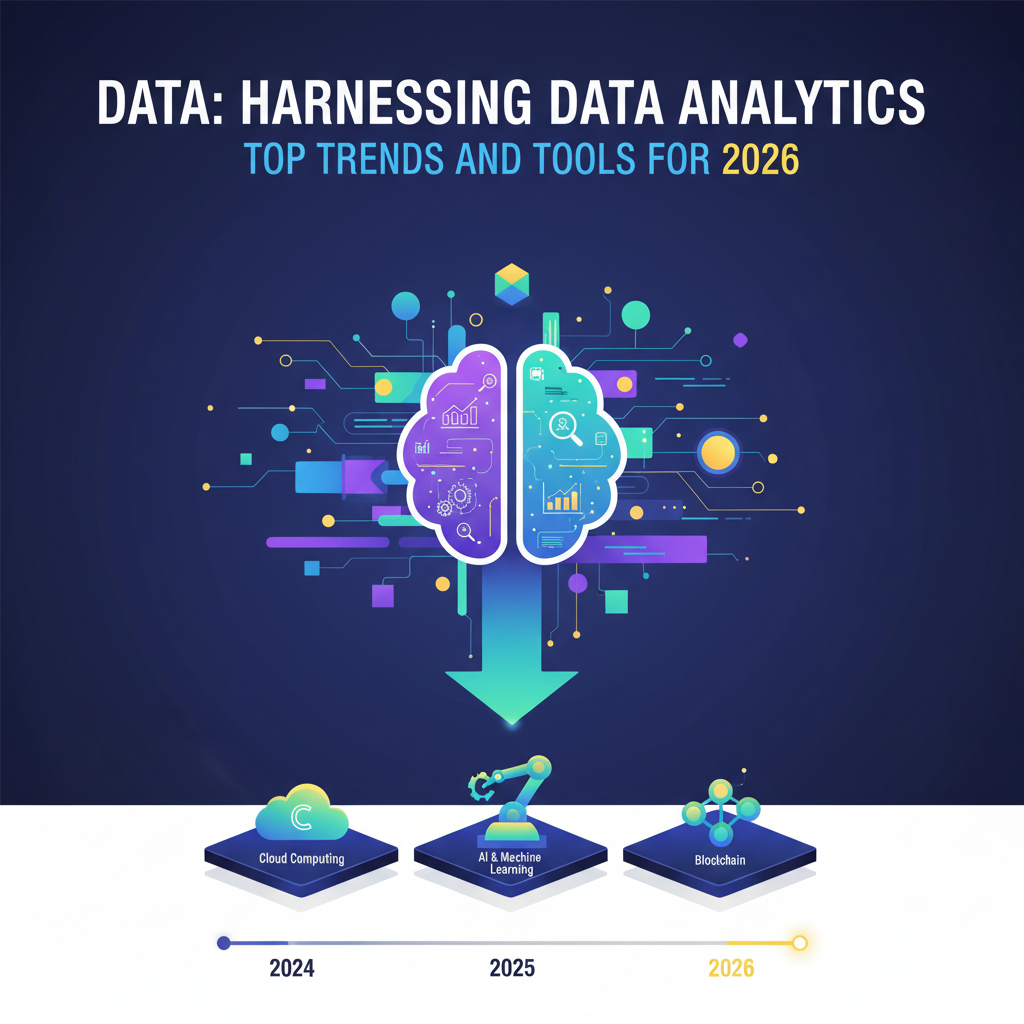
Harnessing Data Analytics: Top Trends and Tools for 2026
In the rapidly evolving business landscape of 2026, staying ahead requires leveraging cutting-edge data analytics trends and tools. By embracing these advancements, businesses can make informed decisions, enhance operational efficiency, and drive growth.
1. Data Democratization: Empowering Every Department
Data is no longer confined to IT departments or specialized analysts. The democratization of data allows professionals across marketing, HR, finance, and other departments to access and analyze data directly. User-friendly business intelligence (BI) tools enable even non-technical staff to generate reports and interactive dashboards without writing code. This shift fosters a data-driven culture throughout the organization, leading to more agile and informed decision-making. (linkedin.com)
2. Augmented Analytics: AI-Driven Insights
Augmented analytics integrates artificial intelligence (AI) and machine learning into the analytics process, automating data preparation, insight generation, and dissemination. This approach accelerates analytics, providing decision-makers with timely and relevant information to inform business strategies. By leveraging AI, businesses can uncover patterns and insights that might be missed through traditional methods. (analyticsinsight.net)
3. Real-Time Analytics: Instant Decision-Making
In today's fast-paced business environment, real-time analytics offers immediate visibility into operations. Organizations are leveraging streaming data platforms to make live decisions, from customer interactions to supply chain movements. Companies using real-time analytics have reported a 21% improvement in customer satisfaction due to faster responses and smarter personalization. (databusinesscentral.com)
4. Synthetic Data: Enhancing Privacy and Scalability
Synthetic data, generated by AI algorithms to mimic real-world data, is becoming essential for training AI models without compromising privacy. This approach allows organizations to simulate various scenarios and test models extensively, particularly in regulated fields such as finance and healthcare. By 2026, it's expected that 75% of businesses will use generative AI to create synthetic customer data. (forbes.com)
5. Data Governance and Compliance: Ensuring Trustworthiness
As data volumes grow, establishing robust data governance frameworks is crucial. This includes ensuring data quality, security, and compliance with regulations like GDPR. Implementing AI-powered data governance tools can automate monitoring, detect anomalies, and ensure adherence to laws in real-time, building trust with customers and stakeholders. (analyticsinsight.net)
6. Embedded Analytics: Integrating Insights into Workflows
Embedded analytics involves integrating analytical capabilities directly into business applications, allowing users to access insights within their existing workflows. This approach enhances decision-making by providing context-specific data without the need to switch between multiple platforms. For example, CRM systems with built-in customer analytics enable sales teams to make data-driven decisions on the spot. (claribi.com)
7. Explainable AI: Building Transparency and Trust
As AI models become more complex, ensuring that AI-driven decisions are understandable and trustworthy is essential. Explainable AI (XAI) provides transparency in AI-generated insights and decisions, helping businesses build trust with customers and stakeholders by clearly explaining how AI systems make decisions. This is particularly important in industries like finance and healthcare, where regulatory requirements demand clear explanations. (jobaajlearnings.com)
8. Data Mesh Architecture: Decentralizing Data Management
Data Mesh is an emerging architectural paradigm that decentralizes data ownership and management. By treating data as a product and having domain-specific teams govern its lifecycle, organizations can effectively and responsively scale their data operations. This approach addresses challenges associated with centralized data architectures and promotes agility in data management. (analyticsinsight.net)
9. Natural Language Processing (NLP): Simplifying Data Interaction
NLP allows users to interact with data using natural language queries, making data analysis more accessible to non-technical users. This technology enables users to ask questions in plain language and receive immediate, easy-to-understand answers without complex queries or coding, fostering a more inclusive data-driven culture. (analyticsinsight.net)
10. Data Literacy: Cultivating a Data-Driven Culture
As data becomes increasingly integral to business operations, fostering data literacy across the organization is vital. Providing training and resources to employees at all levels ensures that they can effectively interpret and utilize data in their decision-making processes. This cultural shift towards data-driven decision-making enhances overall organizational performance and adaptability. (matrix219.com)
Actionable Takeaways for Business Owners
-
Invest in User-Friendly BI Tools: Adopt intuitive analytics platforms that empower employees across departments to access and analyze data, promoting a data-driven culture.
-
Leverage AI and Automation: Implement AI-powered analytics to automate data preparation, insight generation, and anomaly detection, accelerating decision-making processes.
-
Ensure Data Governance: Establish robust data governance frameworks to maintain data quality, security, and compliance with regulations, building trust with stakeholders.
-
Integrate Analytics into Workflows: Embed analytical capabilities directly into business applications to provide context-specific insights within existing workflows.
-
Foster Data Literacy: Provide training and resources to employees at all levels to enhance their ability to interpret and utilize data effectively.
By embracing these trends and strategies, businesses can harness the full potential of data analytics to drive informed decisions, operational efficiency, and sustained growth in 2026 and beyond.
Tags: data-democratization, augmented-analytics, real-time-analytics, embedded-analytics, data-literacy
Estimated Read Time: 7 minutes
Related Articles

Top 3 Data Analytics Mistakes Costing You Clients
Avoid these common data pitfalls to enhance decision-making and client satisfaction.
Harnessing Data Analytics Trends in 2025: A Guide for Business Owners
Explore the latest data analytics trends in 2025 and actionable strategies to leverage them for business growth.
Real-Time Data Analytics: Turning Insights Into Action
Learn how real-time data analytics transforms raw data into actionable business intelligence, enabling faster decision-making and competitive advantages.
Comments (0)
No comments yet. Be the first to comment!